Postman's AI-Native API Platform
API Governance
Close the API Governance Gap. Before AI widens it.
Governance is the framework that sits alongside the API at every step. Postman runs the same rules in the editor, in CI, and across the portfolio, so the workflow itself enforces them. One gate for humans and agents.
Trusted by governance teams at



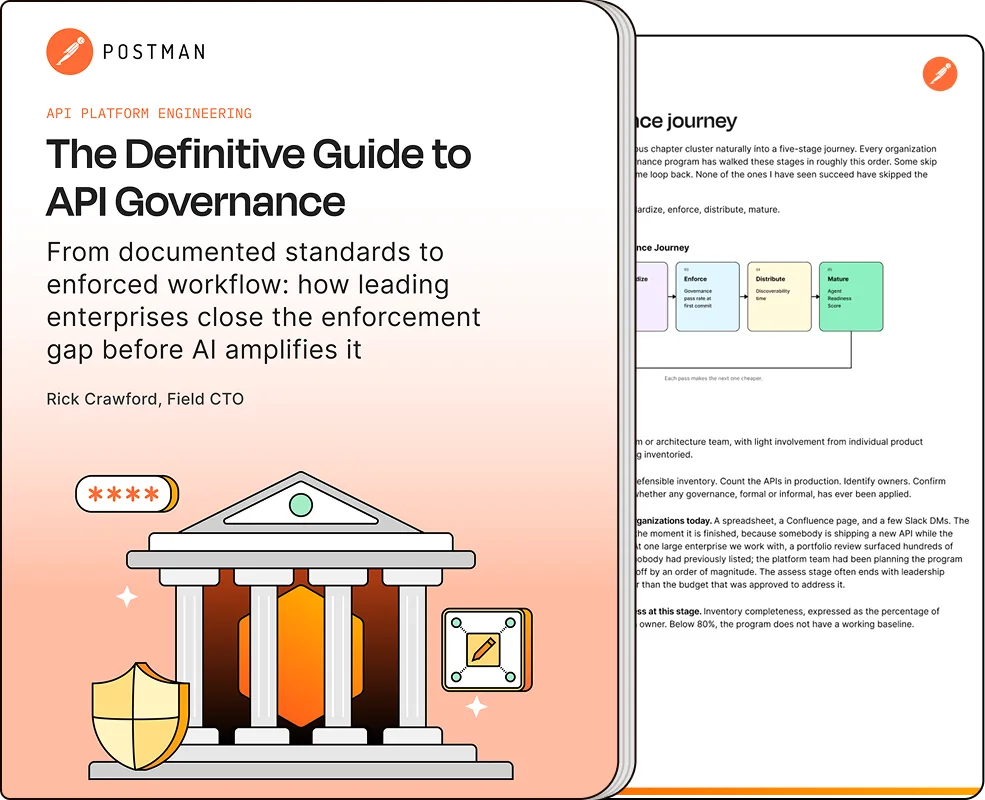
The Definitive Guide to API Governance
From documented standards to enforced workflow. See how leading enterprises close the enforcement gap before AI amplifies it.
SIX CHALLENGES
Where governance programs hit a ceiling
Every governance program runs into the same six structural problems, in roughly the same order, regardless of size or vertical.
Challenge 1
The enforcement gap
Standards live in a wiki the developer didn't read. Nothing runs at the point of authoring. Violations only surface in audits, after the cost of fixing them has multiplied.
- ×Standards live in documentation that nothing executes
- ×Reviews happen after the spec already shipped
- ×Suppression becomes the path of least resistance
Challenge 2
The workflow mismatch
Review boards run longer than a sprint. Engineers stand up their own version of governance because the official one is too slow. Shadow APIs and accepted-violation sign-offs erode the standard one approval at a time.
- ×Review queues become multi-sprint bottlenecks
- ×Shadow APIs proliferate as engineers route around the gate
- ×DORA: gates over 10 minutes get bypassed
Challenge 3
The visibility gap
Nobody can produce a current portfolio with owners, compliance posture, and consumer surface. The wiki is two years stale; the spreadsheet has been forked seven times.
- ×Inventory goes stale between audits
- ×Duplicate APIs ship because the canonical version is undiscoverable
- ×78% of enterprises don't know how many APIs they have
Challenge 4
Regulatory pressure forcing the conversation
EU DORA, PCI-DSS 4.0, FHIR, HIPAA. Compliance officers now show up in engineering's quarterly review because the regulation requires them to. Posture has to be validated continuously for audit defense.
- ×DORA covers ~22,000 financial entities since January 2025
- ×PCI-DSS 4.0 added 64 new requirements in March 2025
- ×Audit evidence accumulates as a side effect of governance
Challenge 5
The agentic blind spot
Coding agents produce specs at machine velocity with little awareness of standards. Runtime agents fail on inconsistencies humans used to absorb. 51% of organizations have deployed AI agents but only 24% design APIs with agent consumption in mind.
- ×Agents produce specs that violate every standard the org wrote
- ×MCP makes governed APIs the agent's discovery surface
- ×One ruleset must cover human and agent authors alike
Challenge 6
The doom loop
Documentation didn't enforce. The review board became a bottleneck. The program collapsed. A new initiative starts; engineers who lived through the last attempt are skeptical. Workflow-native enforcement at the point of authoring breaks the loop.
- ×Previous fixes tried to close the gap with documentation
- ×Suppression with no consequence trains the team to bypass
- ×Workflow-native enforcement is what sticks
THE POSTMAN PLATFORM
One platform for every stage of the API governance journey
Postman replaces fragmented governance with a single platform that developers actually use.
Assess
Standardize
Enforce
Distribute
Mature
Know what you have before you govern it
- Spec Hub: Centralize OpenAPI 2.0/3.0/3.1, AsyncAPI 2.0, protobuf 2/3, and GraphQL specs in one design surface.
- API Catalog: A live inventory with owner, lifecycle stage, conformance summary, and CI/CD pipeline status for every API.
- Postman CLI: Refresh catalog state continuously from Git, gateways, and CI jobs.
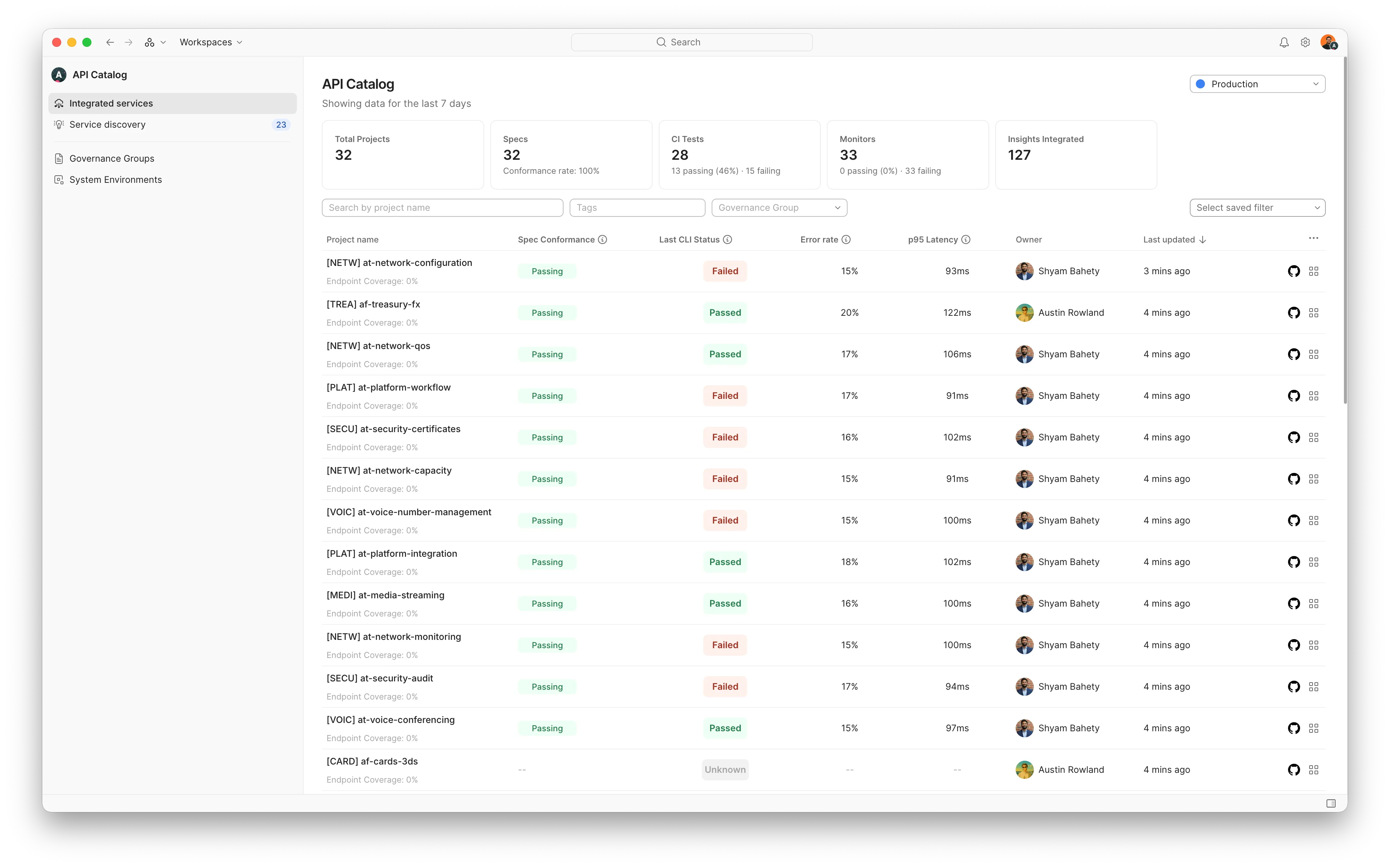
A live portfolio view: every API, its owner, conformance, and the latest CI run, refreshed as the team works.
Make standards machine-runnable
- Rule Library: Ships with Postman's API governance guidelines, Zalando's RESTful and event guidelines, and Postman's OWASP API guidelines as a baseline.
- Custom Rules: Extend the library with Spectral rules that encode your own naming, error, and ownership conventions.
- Governance Groups: Apply stricter severities to regulated workspaces than to internal experimentation teams without forking the ruleset.
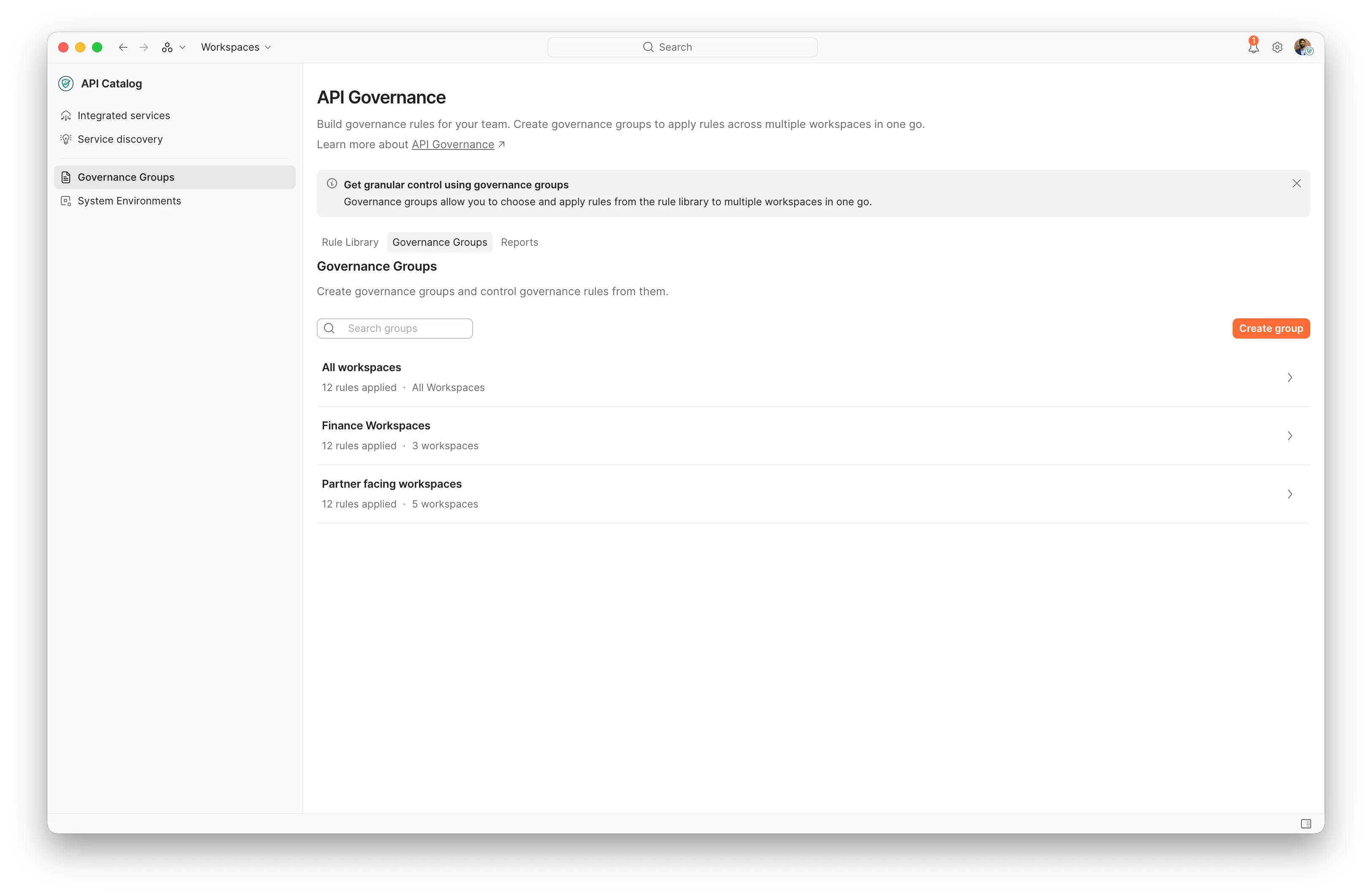
Apply the same rule library to all workspaces with different severities per group.
Close the enforcement gap
- Spec Hub linting: Inline rule feedback as the developer authors, before the spec is committed.
- Postman CLI: Same ruleset as the CI merge gate, with violations surfaced in the CI tool, console, or platform.
- Postman Vault & Secret Scanner: Keep credentials out of collections and surface exposed secrets in published workspaces.
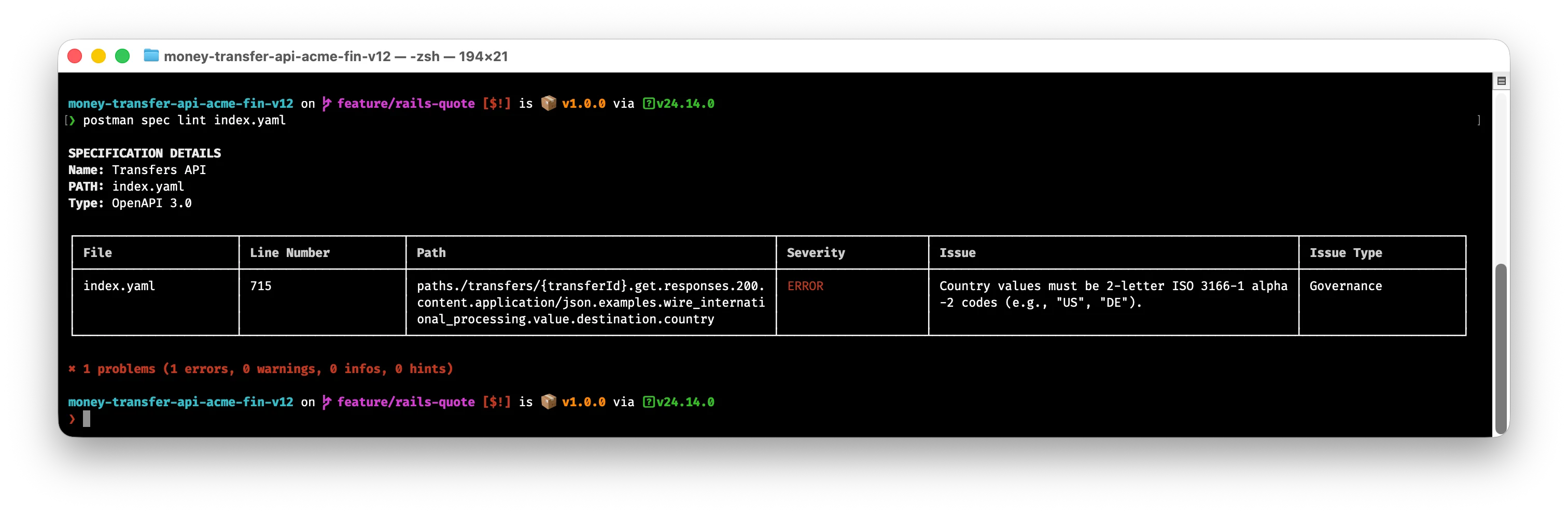
The same rules that fired inline in Spec Hub run in CI via the Postman CLI.
Make governed APIs findable everywhere
- Private API Network: Internal workspaces feed a discovery surface for cross-team reuse, fixing the duplicate-API problem at its root.
- Partner Workspaces: Curated B2B surfaces with workspace-level access controls and multi-partner mode.
- Postman API Network: Public workspaces extend reach to the external developer ecosystem; the Run in Postman button lowers the first-call barrier to a single click.
- SDK Generator: Typed client libraries in TypeScript, Python, Java, PHP, Go, and C# from a single OpenAPI spec.
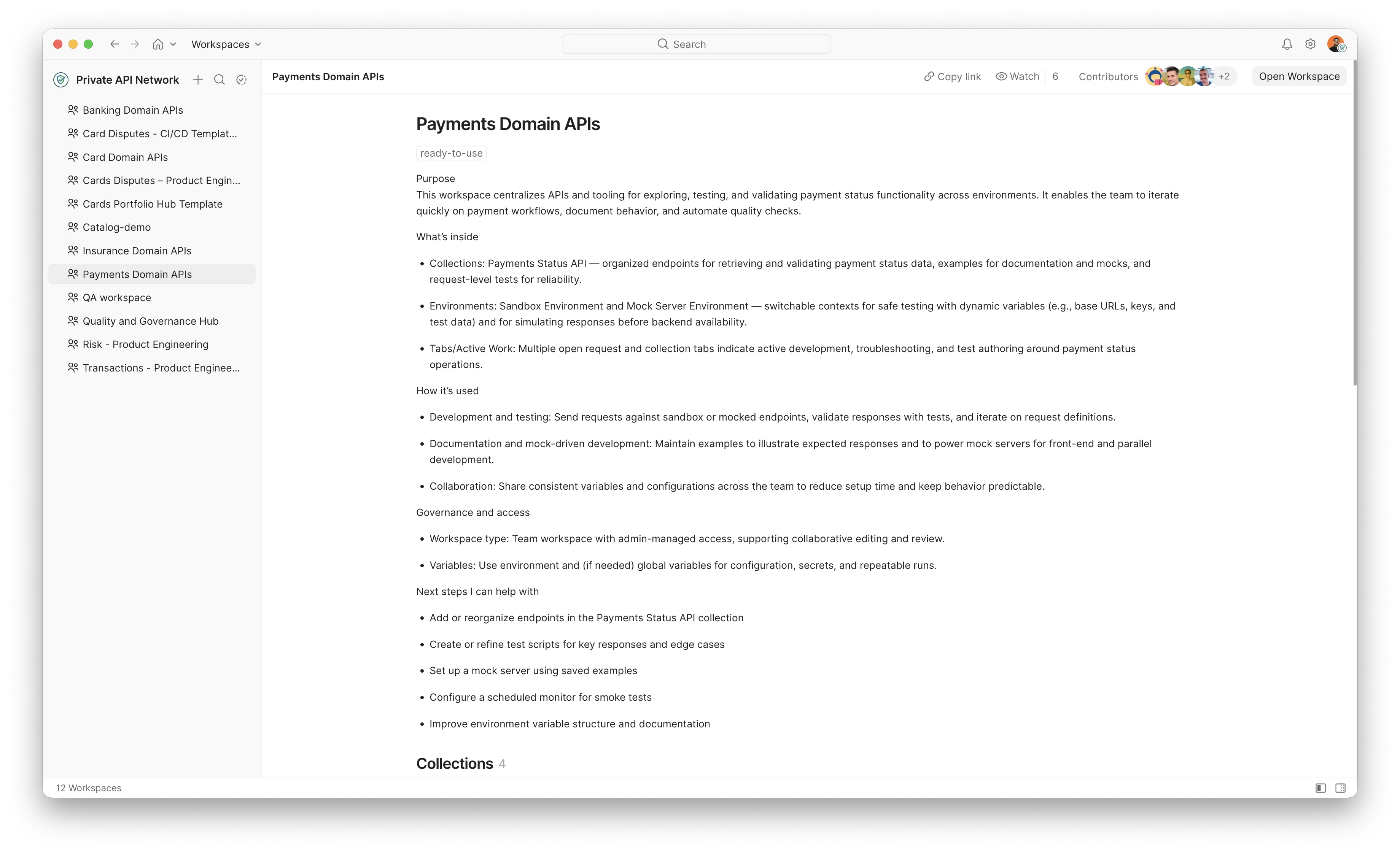
Private API Network ends Slack-thread discovery and duplicate API creation.
Extend governance to AI
- Postman Insights: Validate the catalog's posture against how humans and agents call the API.
- Audit Logs: Structured evidence emitted as a side effect of every governance run, for compliance prep without forensics.
- Agent Mode: Apply the same governance rules to AI-authored specs, with violation feedback in line before the spec is committed.
- Postman CLI + skills: Coding agents run spec lint locally through the Postman CLI and its skills, before commit, using the same ruleset CI enforces.
- MCP Generator + MCP Catalog: Expose governed APIs to agents as MCP servers with a discovery surface for what's available.
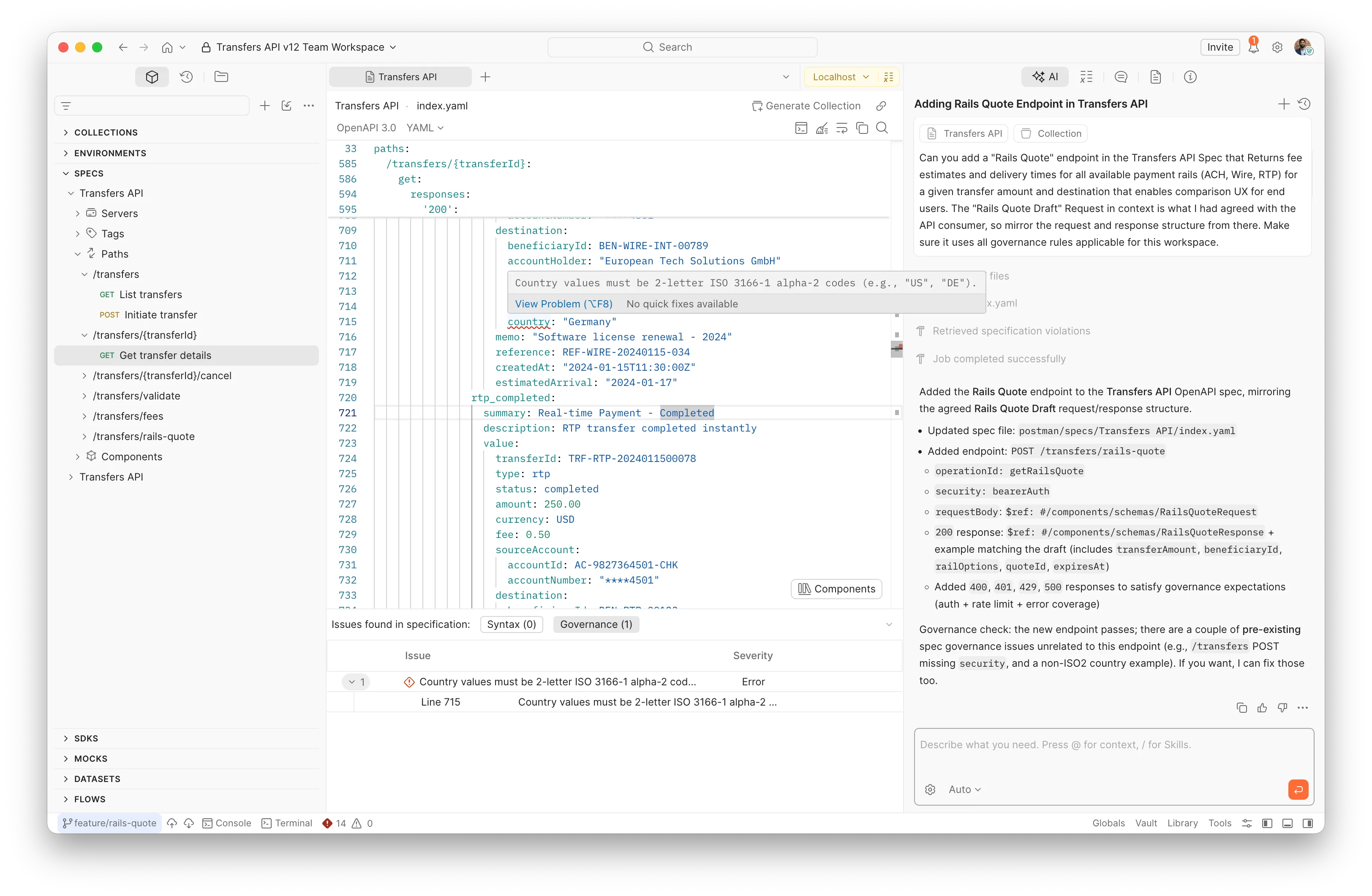
The agent that produces the spec sees the same violation feedback the developer would, in line, before the spec is committed
The Definitive Guide to API Governance
From documented standards to enforced workflow. See how leading enterprises close the enforcement gap before AI amplifies it.